Table of Contents
Ever had that moment in a reading where it feels like the cards are screaming at you?
Where they all seem to be singing from the same hymn sheet, pointing towards the same thing, making it impossible to ignore?
That’s what happens when you stop seeing cards as objective definitions and start recognising them like words in a language.
Think about the word “shit.”
It can mean something’s awful: “That’s shit.”
It can mean something’s incredible: “That’s shit hot.”
It can mean someone’s lying: “That’s bullshit.”
Same word. Completely different meanings depending on context.
Tarot cards work the same way.
Strength doesn’t always mean the same thing. Queen of Swords shifts depending on what’s next to it. Justice changes based on the conversation.
They’re not rigid definitions. They’re adaptable. Twistable. Context-dependent.
And when you start reading them that way – when you see how they connect to each other instead of just listing what they mean in isolation – that’s when readings stop feeling like textbook recitations and start landing like actual insight.

If you’ve been reading tarot cards one at a time and wondering why your readings feel disconnected, this is why.
That’s what this post is about. How cards connect. How do they create meaning through conversation with each other? How to read tarot card combinations instead of just card-by-card definitions.
The Problem with Reading Card-by-Card
You’ve learned tarot card meanings. You can name every card in the deck. You know the traditional interpretations.
So why do your readings still feel disconnected?
Because you’re reading them like a list.
Card one means this. Card two means that. Card three means something else.
But that’s not how tarot works. Cards don’t exist in isolation. They speak to each other. They create patterns. They build tension. They form narratives.
The meaning isn’t in the individual cards. It’s in how they connect.
How Tarot Card Combinations Actually Work
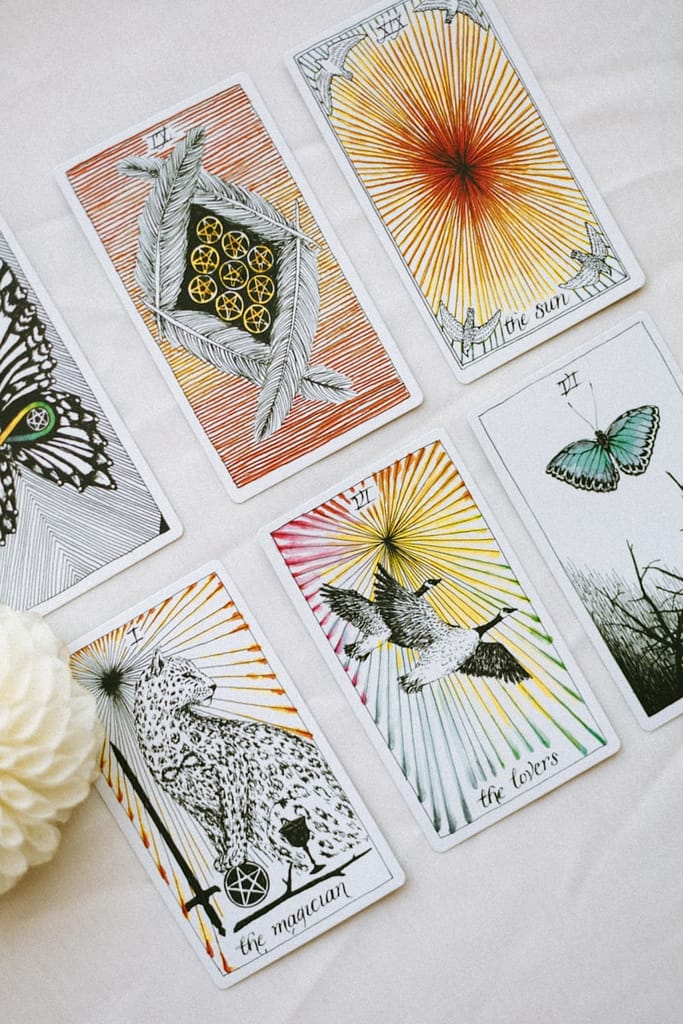
When cards show up together, they’re not just sitting next to each other. They’re in conversation.
Here’s how that conversation happens.
Connection 1: Repeating Themes Create Emphasis
I pulled three cards in a reading once: Strength, Queen of Swords, Justice.
Three different cards. But all saying the same thing: balance.
Strength is about balancing instinct with wisdom. Queen of Swords is about balancing head and heart. Justice is literally the card of balance.
If I’d read them separately, I would have said: “Strength means inner power. Queen of Swords means clear thinking. Justice means fairness.”
That’s three different concepts.
But together? They were screaming one message: you don’t have balance anywhere in your life right now.
That’s how repeating themes work in tarot card combinations. When multiple cards point to the same concept, they’re not just mentioning it. They’re emphasising it. Making it impossible to ignore.
Connection 2: Contradictions Create Tension
The Fool and the Eight of Swords together create tension because they pull in opposite directions.
One says “leap.” The other says, “You’re trapped.”
That tension IS the reading. That’s where the insight lives.
When you see cards that contradict each other, don’t smooth it out by reading them separately. Lean into it. Ask: What does this tension tell me about what’s going on?
Usually, it’s showing you exactly where someone is stuck.
Connection 3: Suit Patterns Show You the Realm
If you pull five cards and three of them are Swords, the situation is happening in the mental realm. Thoughts. Analysis. Overthinking.
Three Cups? It’s emotional. Relational. About feelings.
Multiple Wands? Instinct. Impulse. Gut reactions.
The suit pattern tells you what realm the person is operating in before you even look at the specific cards.
That’s information you lose when you read card-by-card.
Connection 4: Timing and Conversation Change Everything
I pulled the Ace of Cups reversed in a reading.
On its own, that card means blocked emotions. Something you need to release, but you’re not letting it out.
Standard interpretation.
But then the person said, “I had a panic attack at work. I haven’t told anyone.”
And suddenly that card wasn’t just “blocked emotions.”
It was THIS. This specific thing they were carrying alone.
The card didn’t change. What it meant changed completely based on what they said.
That’s how conversation connects cards. The person’s response gives context. And context changes meaning.
Then I pulled Strength right after they shared that.
Strength is about vulnerability. About connecting through your softness, not just your toughness.
If that card had come out before they spoke, it would have meant something different. But it came out after they’d done the vulnerable thing – told me something they hadn’t told anyone.
The timing made it land differently.
Think of Tarot Card Combinations Like Language
You wouldn’t read a sentence word by word and expect it to make sense.
“Cat” means cat. “Sat” means sat. “Mat” means mat.
But “The cat sat on the mat” tells you something those individual words don’t.
Tarot works the same way.
Individual cards are words. Combinations are sentences. And readings are conversations.
If you’re only reading the words, you’re missing the story.
How to Start Seeing Connections
Next time you pull cards for a reading, try this:
Step 1: Lay them all out before interpreting anything
Don’t read card one, then card two, then card three. Look at all of them together first.
Step 2: Notice patterns
- Are multiple cards from the same suit?
- Do multiple cards share a theme?
- Are there contradictions or tensions?
- What’s the overall visual impression?
Step 3: Ask how they connect
Not “what does this card mean?” but “how does this card speak to that card?”
The Fool next to the Eight of Swords doesn’t mean “new beginnings AND mental paralysis.” It means “you want new beginnings, but mental paralysis is stopping you.”
That’s a connection. That’s a story.
Step 4: Let the person’s response shape what you see
When someone reacts to what you’ve said, that changes what the cards mean. Pay attention. Let their words add context.
The cards are landmarks. The conversation is the path between them.
What About Spread Positions?
If you’re using a structured spread like the Celtic Cross, position adds another layer of connection.
The same card in different positions creates different stories.
The Six of Cups in the past position connects to your history. In the future position, it connects to what’s coming. In the subconscious position, it connects to what you’re not acknowledging.
Position is context. And context changes how cards connect to each other.
Tarot Card Combinations Are More Than the Sum of Their Parts
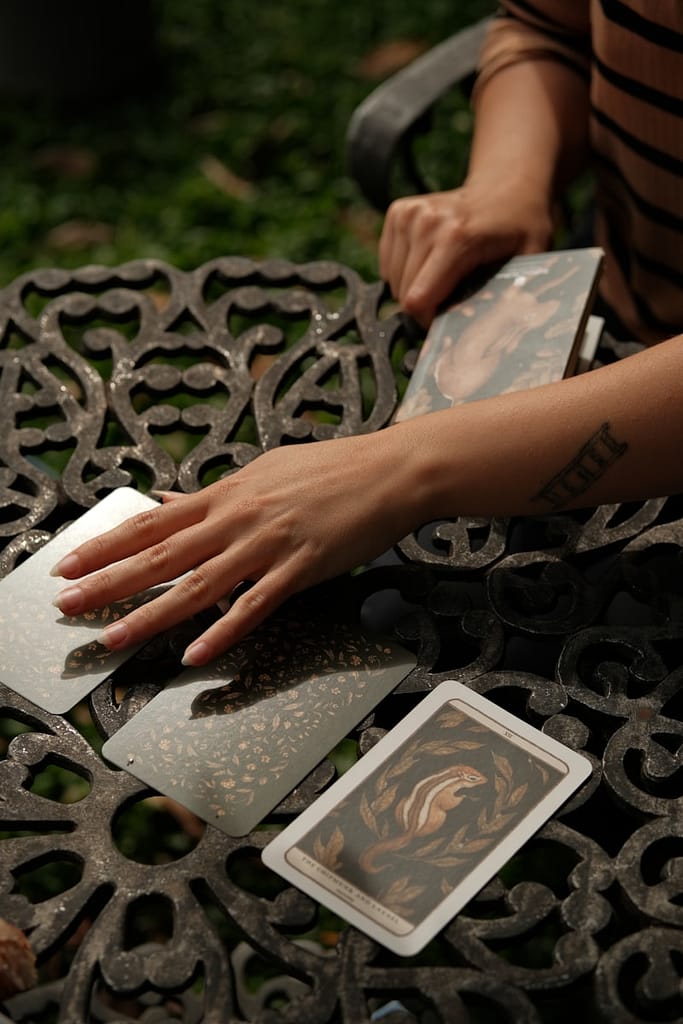
You can’t just add card meanings together like maths.
The Fool + Eight of Swords isn’t “new beginnings + mental paralysis.”
It’s a story about paralysed potential. About wanting something and being trapped by your thoughts at the same time.
That meaning isn’t in either card individually. It’s in the combination.
That’s what you’re looking for when you read tarot. Not individual definitions. The way cards create meaning through connection.
Stop Reading Like a Dictionary
Learning tarot card meanings is important. You need to know what The Fool represents. What the Eight of Swords brings. What Justice means.
But if that’s all you’re doing, you’re not reading tarot.
You’re reciting definitions.
Tarot works when cards speak to each other. When they create patterns. When they build tension. When they form narratives that are bigger than any single card.
That’s how to read tarot card combinations.
Not by memorising more meanings. By paying attention to how cards connect.
Want to see how this works in your situation? Book a reading, and I’ll show you how the cards connect in your life. Or learn to read connections yourself at Simply Tarot Circle.