Table of Contents
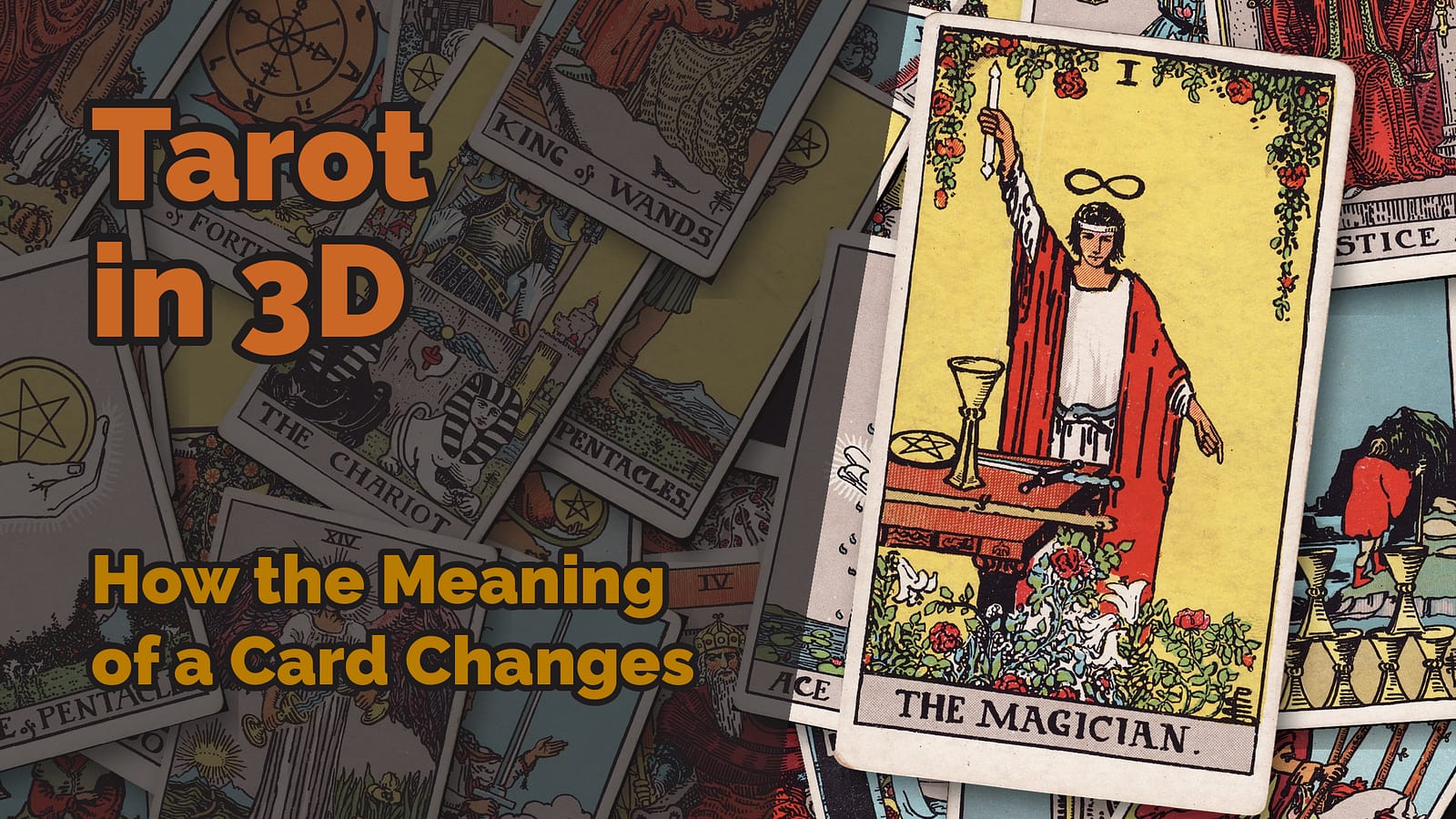
At Simply Tarot Circle, we held up the Magician and asked it “What’s going wrong in my relationship?” and the room went straight to power: somebody holding all the cards, and a raised hand that suddenly looked quite aggressive. Then we asked the same card “What’s going well in my career?” and it turned into a garden in full bloom, with everything coming together because the work had already gone in. It’s the same picture both times, and we got two completely different readings out of it.
Often we think of tarot card meanings as something you just learn. You pick up the book, you look up the Magician, it gives you resourcefulness or manifestation or whatever, and that’s the card sorted. But you can know every meaning in that book and still get completely stuck when the card turns up in an actual reading, because there are three things that change what a card says to you, and you’re not going to get any of them from a typical guidebook: the deck you’re using, the question you’re asking of it, and the cards around it.
I’ve been calling it Tarot in 3D. It started at Simply Tarot Circle, when people asked if we could look at the same card across different decks, and it turned into a run of Sundays where we use one card, the Magician, and change everything around it.
Why We’ve Only Used the Magician
Keeping one thing still
If you want to see what the deck, the question and the other cards are doing to a card, the card itself has to stay put. So every week it’s been the Magician, for that consistency, and everything else has been allowed to move.
At the start of the second week I asked everyone what the Magician means to them on its own, out of any context. The answers were things like doing the work, having all the tools you need, infinite possibility and bringing things together. That fits with what’s in the Rider-Waite-Smith picture: a figure at a table with a cup, a pentacle, a sword and a wand in front of them, one hand pointing up to the sky and one pointing down to the ground, an infinity symbol over their head, and roses and lilies growing all around them. That one hand up, one hand down is what people call as above, so below, the connection between the spiritual side of life and your day-to-day. Everything you need is on the table. That was our starting point, and then we started changing everything around it.
The Deck You’re Holding
The first dimension is the card itself, meaning the actual picture you’re looking at and that particular version of it. Whether you’re reading with the Rider-Waite-Smith, the Fountain Tarot, the Wild Unknown Tarot, the Tarot de Marseille, the Thoth Tarot, the Fifth Spirit Tarot, the Light Seer’s Tarot, the Spacious Tarot or whatever, the image is going to bring something to the reading that might not be there if you were using another deck, or if you were just reading a guidebook.
Fifty Magicians in one evening
For the first week I asked everyone to bring along all of their decks, and between us we looked at the Magician in about fifty different versions. Some things turned up nearly everywhere. Most of them had the four suits on the table in some form, a cup, a wand, a sword and a pentacle, and the infinity symbol kept turning up as well (in the Wild Unknown it’s on the leopard’s chest, which is quite cute).
But it’s what changed that got interesting. In the Rider-Waite-Smith the figure looks quite authoritative, stood there making a stand in a very active kind of pose. Then in the Pagan Tarot it’s so much softer, and in the Light Seer’s Tarot they’re bowed down like they’re meditating, and it’s not very showy at all. The one in the Fountain Tarot feels like an introvert to me, whereas the one in the Tarot de Marseille looks like they’re having a great time.
And other people’s decks did things mine didn’t. One deck swapped the flowers for crystals, and the person reading with it said that’s why they read the card more as healing. They also said they hadn’t even noticed the flowers in the Rider-Waite-Smith until they saw the crystals and went back to look. Another had a levitating table, a big showy outfit and the kind of sleeves you could hide things up. To the person holding it, the whole card felt a bit tricksterish, more like an illusion than somebody actually doing something. It’s the same card in every one of those decks, and people were reading something different off each of them.
The decks you’re not even holding
Sure, the deck you’re using might come with a guidebook, but that guidebook is only ever going to show you stuff from that one deck. And it goes beyond the deck in your hands, because it’s all the art you’ve ever seen for that card.
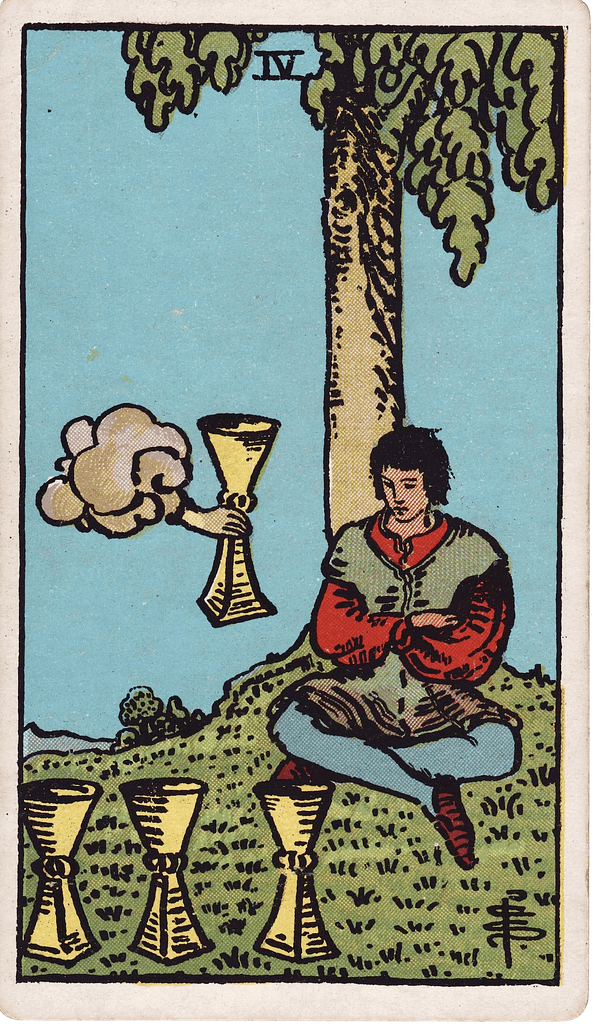
Even if I’m doing a reading with the Wild Unknown, I might remember something I’ve seen in the Mystic Mondays Tarot. The Modern Witch Tarot looks really similar to the Rider-Waite-Smith, and even when I’m reading with the Rider-Waite-Smith, sometimes I’ll remember the way a card’s drawn in the Modern Witch, like the Four of Cups. In the Rider-Waite-Smith the person’s sat up against a tree with their arms folded, looking kind of disappointed. In the Modern Witch they’re sat up against a wall, I think, wearing a hoodie that says “over it”. That always springs to mind when I see this card, and I’ll often bring it up even when I’m not using that deck, because it’s part of what I’m drawing on when I look at the card. I picked that up from a deck, and there’s no guidebook that would have given it to me.
The Question You’re Asking
What you bring to it
The second dimension is the question, and this one’s you. It’s what you’re bringing to the reading, separate from whatever the deck has brought, or whatever you remember from other decks.
You might be asking the card about the breakup you’re going through, the job you’ve just been offered, the house move that’s about to happen, the ways you need to look after yourself right now, or the blind spots you’ve got with a colleague. Whichever it is, that question changes how you look at the card and what you get from it. Is this your daily focus card? Is it the thing that’s getting in your way? Is it your brand new marriage, or your divorce? Is it upright, or is it upside down? There aren’t really any guidebooks that can tell you how your question changes a card, because you’re the one bringing it.
Same card, opposite questions
That relationship and career pairing was the second week. We held up the same Magician and asked it different questions, one at a time, and those first two pulled against each other on purpose.
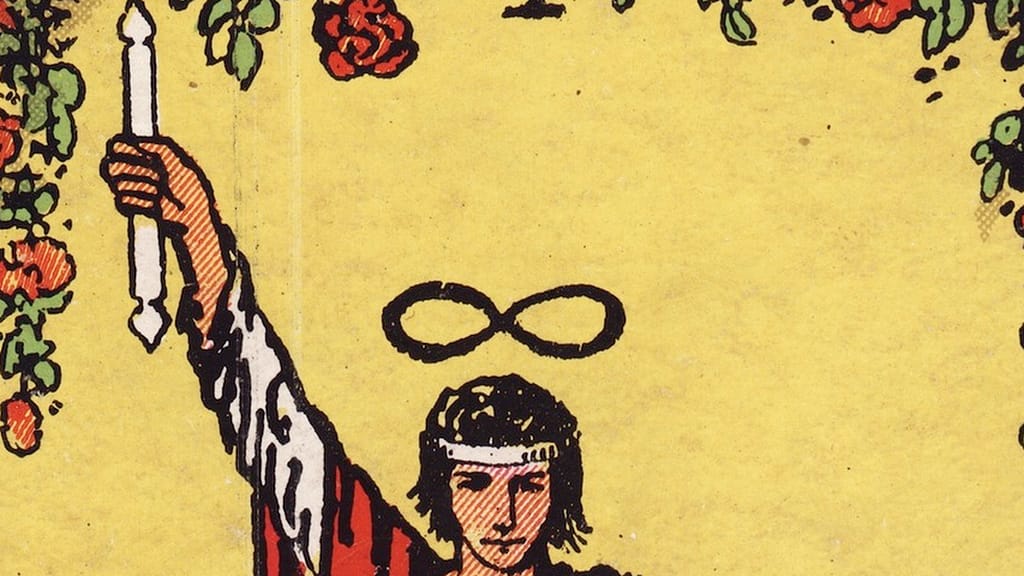
With the relationship question, someone pointed out that the Magician’s holding all the cards, and they’re literally on the table. One person said the raised hand looked quite aggressive, and once they’d said it I was seeing it too. I usually see that hand as as above, so below, this sort of cosmic thing, and now it looked like they were raising a baton. Someone else took the as above, so below and turned it into two people mirroring each other, both of them with all the tools they’d need to fix things and neither of them picking one up.
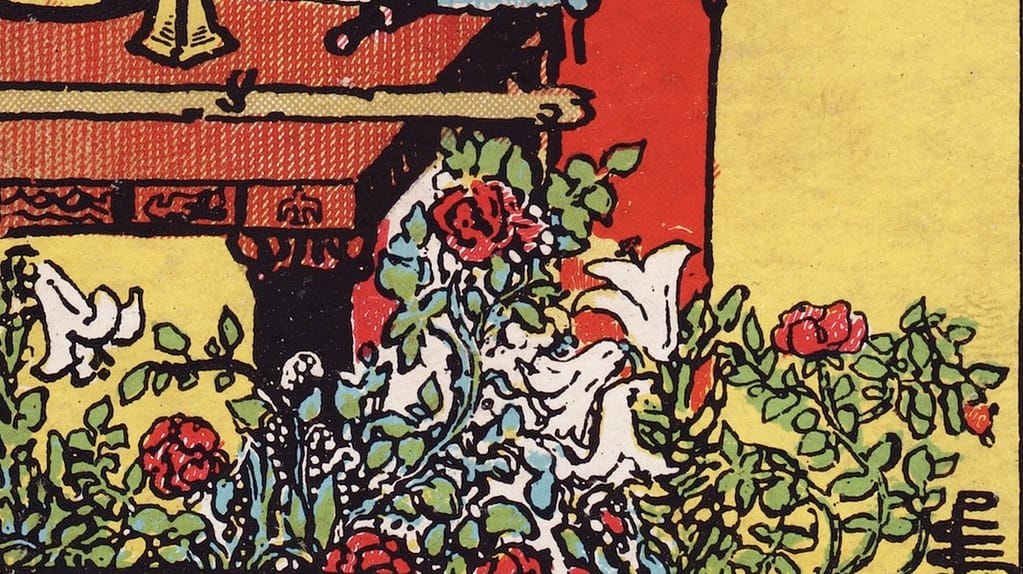
Then we flipped it to “What’s going well in my career?” and the same card was a garden in full bloom. People noticed the healthy roots, the greenery and the flowers, and everything felt abundant. Someone looked at the four tools on the table as separate skills they’d worked hard to build, and said that to really be the Magician you’ve got to pull all of those together. So it could be advice to do exactly that, or it could be saying you’re already doing it, and everything’s going well because you put the hard work in beforehand. We’d moved from love to career, but we’d also changed the nature of the question from what’s wrong to what’s good, and the same picture answered both in its own way.
When the question is a decision
When we asked it “What should I focus on this month?” it got a lot more blunt. You’ve got everything that you need, so why are you still waiting for somebody to tell you what to do? Just get on with it.
And when we asked it “Should I take the job?” somebody said yes straight away because the hand’s up, and then we got into whether the job itself changes the answer. If I’m asking whether I should become a magician, it’s probably a good sign. If I’m asking whether I should become a bin collector, maybe not. Someone else said it all came down to preparation. If it’s something you’ve been working towards, brilliant, and if you’re jumping at the first thing that’s come along, maybe wait for something that suits you better. And somebody else saw the raised hand as a stop, as in wait a minute and have a think about it.
Either way, the decision’s still yours, and what the question does is change what you notice in the card.
The Cards Around It
Me, you and them
The third dimension is all the other cards you pull and how they change the way you read this one. The examples in this part are my own rather than from the room. If I’m talking to my deck, it’s me, you and them: me with my question, the card in front of me, and the cards around it.
The other cards can focus the meaning. If the Magician comes out alongside the Empress, what you’re creating is much more organic. You’re growing something, and maybe you’re paying more attention to the lilies. If it’s alongside the Emperor, it’s more about the tools and the workbench and actively getting shit done rather than pottering about nurturing shit. And with the Four of Swords, it might be telling me there’s a lot of ingredients in the cupboard and I don’t need to be using them right now. I just need to mull them over first.
When they all share something
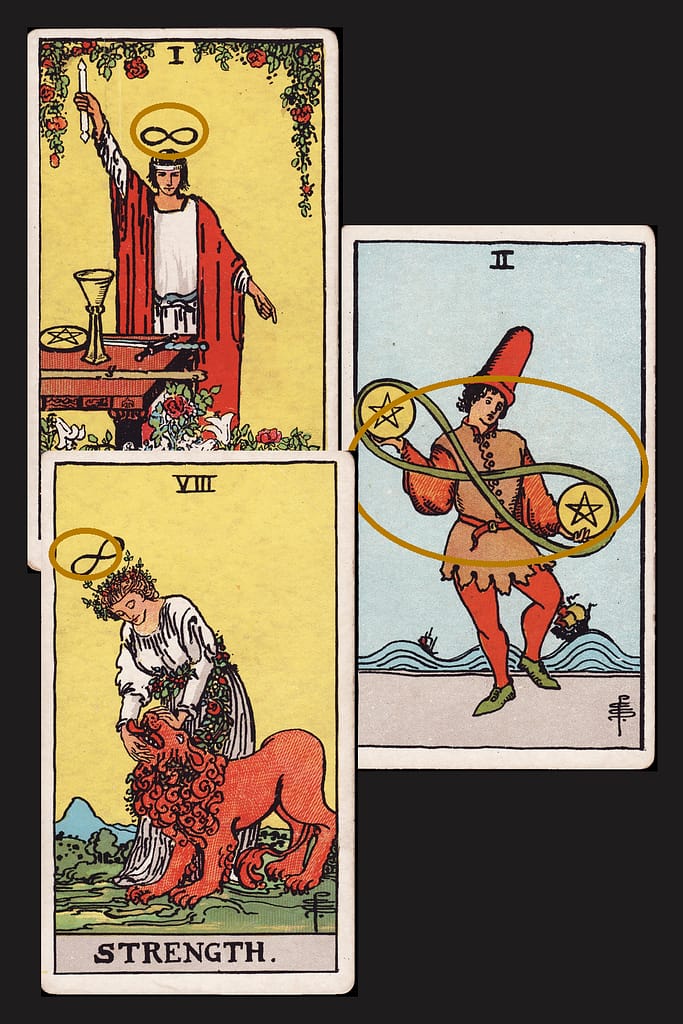
Sometimes the other cards change what you’re looking at completely, because every card you’ve pulled shares a motif. Say I’ve been for an audition for a film and I’m asking whether I’ve got the potential to make it. I pull the Magician, the Two of Pentacles and Strength, and straight away I’m seeing the infinity symbol, the lemniscate, across all three of them. I’d take that as a really strong sign that yes, I’ve got the potential, but that doesn’t mean it’s going to be plain sailing, because the Two of Pentacles is reminding me it’s going to take a Doctor Strange in Avengers: Infinity War level of planning for every eventuality.
I’ve written more about how cards talk to each other in my post on tarot card combinations, if you want to go further with this bit.
Try a Card in 3D
Three things to ask it
If you want to try this yourself, you only need one card and a few minutes.
- The deck. Pull a card and look at the picture before you think about what it means. What do you notice in this version of it? And if you’ve got another deck, or you remember how another deck draws it, what does that one bring?
- The question. Ask it two questions that pull against each other, like what’s going wrong and what’s going well, and notice what you look at first each time.
- The cards around it. Pull one or two more and put them next to it. What jumps out now that didn’t before, and is anything repeating across all of them?
You Bring One of the Three
Where the meaning comes from
A guidebook will give you a list of what the Magician means, and that’s a fine place to start. But it can only ever show you its own deck, and it has no idea what you’re asking or what you pulled next to it. The deck brings the picture, the other cards bring the rest of the story, and you bring the question, and the meaning comes out of all three together.
Try it with other people
What’s made this run so interesting is hearing how everyone else sees the same card. My goal in these circles is to speak as little as possible, so a lot of what’s in this post came from the room.
If you’d like to try it, Simply Tarot Circle is every Sunday, live online, and your first three are free when you sign up on that page. It’s part of Simply Tarot Membership, so if you stay, that’s where it lives, along with everything else I make.

Leave a Reply