Three of Swords Tarot Card Meaning
Upright Keywords
- Heartbreak
- Emotional Pain
- Overthinking
Reversed Keywords
- Healing
- Recovery
- Relief
The pain of a necessary truth. The Three of Swords represents heartbreak, emotional pain, and the grief that follows when something you believed turns out not to be true. Three blades pierce a heart against a stormy sky. This card acknowledges that some truths hurt deeply, but the wound only heals when you stop avoiding it and let yourself feel it fully.
Three of Swords Imagery and Symbolism
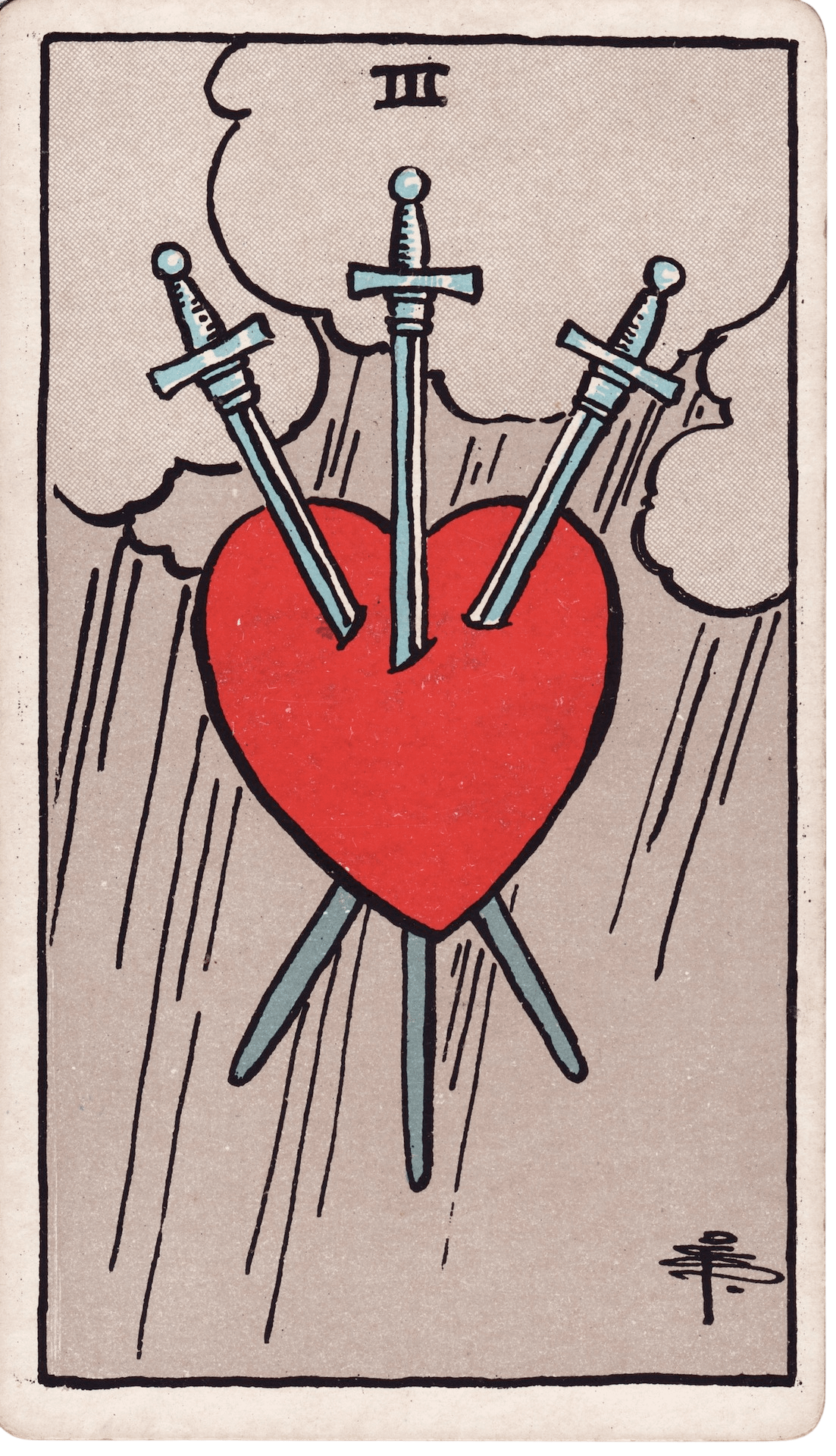
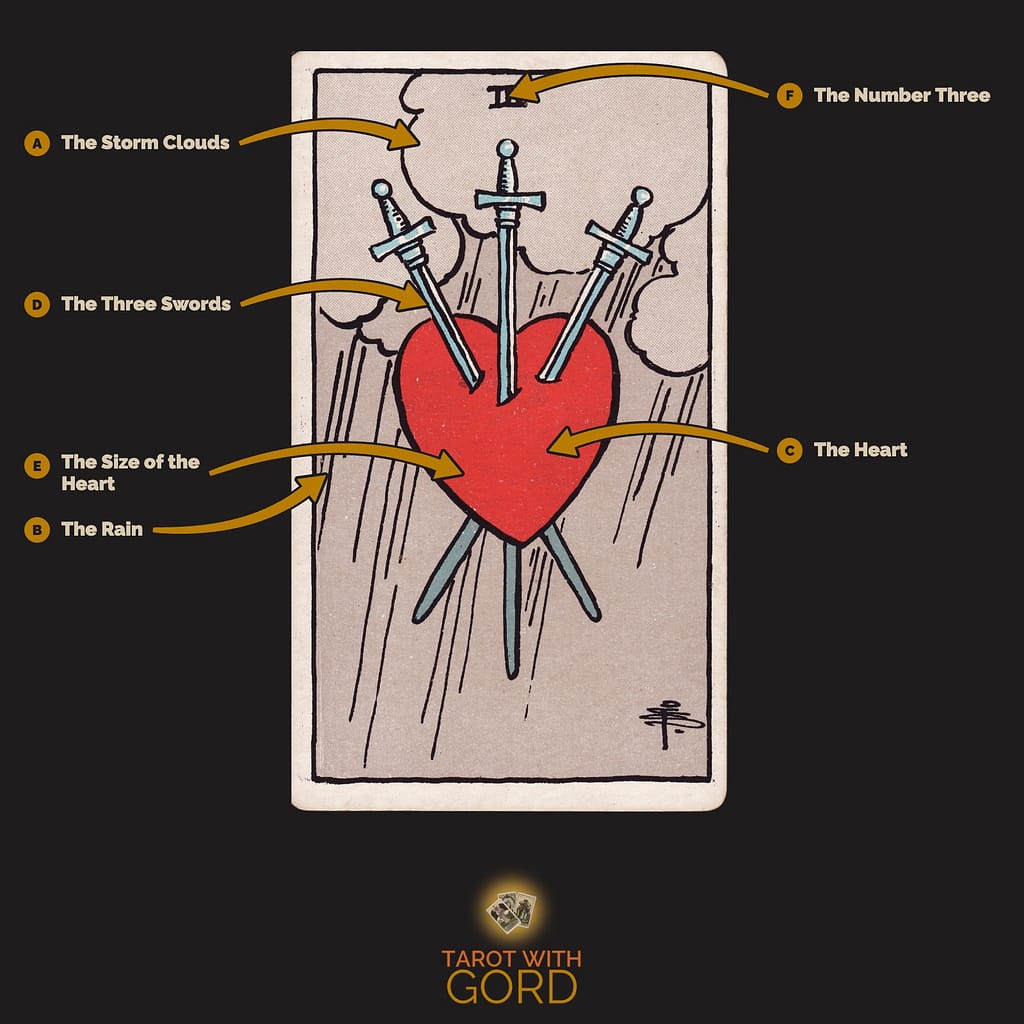
Heavy grey clouds gather behind the heart against a flat grey sky. Storms are traditionally tied to trouble that doesn't last forever. Does it look like it's passing, or settling in?
Grey rain slants down across the whole card. Rain is traditionally tied to tears, and some people read it as a kind of washing clean. Which way does it feel to you?
A big red heart fills the middle of the card, and there's no person anywhere. Pamela Colman Smith left the figure out, so there's nobody to watch and nobody in the way. It's just the heart, much bigger than the swords going through it. The Empress has a heart on the shield beside the throne. Whose heart is this?
See also: The Empress
Three swords go straight through the heart and come out the bottom, so nothing's just scratched the surface. Tradition reads them as three different cuts to one heart, the thing that happened, the way it happened, and what you can't stop replaying. Which of those cuts deepest?
The heart fills the middle of the card and the swords look small next to it. Tradition reads the heart as far bigger than what's hurting it. What does that say about how much a heart can take?
The Three of Swords is a three. Threes are traditionally growth and expression, the first real sign of something, and here what's showing is the hurt. Some people read them beside the Empress, card three of the Majors.
See also: The Empress
Building Your Relationship with Three of Swords
The meanings and symbolism above are the shared language we all start with. But every reader develops their own interpretations and stories for each card over time. Here's some of mine:
Swords are thoughts, and the Three of Swords is emotional pain you're trying to logic your way out of. I learned something useful from a marriage course I once did production for: talking about your feelings actually stops you from feeling them. That's this card. You're ruminating, dissecting, analysing why someone hurt you. Stop. Stop fucking thinking about it and actually feel your feelings. That's how you heal.
You can read more of my thoughts on Three of Swords and every other card in my working notes, available exclusively to members, alongside everything you need to build your own practice.
Three of Swords Tarot Card Meaning Upright
Heartbreak
This card represents heartbreak that goes beyond romantic loss. It covers any piercing of trust, whether betrayal, harsh words, or deep disappointment. It asks you to acknowledge the wound honestly rather than explain it away. The ache is real, and pretending otherwise only delays recovery.
Emotional Pain
This card represents emotional pain that is raw and present. It sits in the body as much as the mind. Grief, sorrow, the churning feeling after a loss or letdown. Numbing it or intellectualising it keeps it lodged in place. Feeling it properly is what allows it to move through.
Overthinking
This card suggests overthinking showing up when you replay conversations, dissect motives, and try to understand your way out of hurt. You're using more thoughts to solve a feelings problem. Recognise the spiral and redirect toward actually experiencing the emotion instead of analysing it to death.
Three of Swords Tarot Card Meaning Reversed
Healing
This card reversed can suggest healing has begun. The worst has passed and the mending is underway. Wounds may still ache, but you're no longer picking at them. Forgiveness, whether for yourself or someone else, starts to feel possible. Let the process continue at its own pace.
Recovery
This card reversed can suggest recovery, the rebuilding phase. You've processed the grief and are starting to integrate what you've learned. Old pain becomes wisdom rather than a fresh wound. Give yourself credit for getting through it, and resist the urge to rush what still needs time.
Relief
This card reversed can suggest relief arriving as lightness after a long cry. The pressure lifts. Thoughts stop circling the same painful loop. You can breathe again. This doesn't mean you've forgotten. It means you've processed enough to function without the weight of unresolved anguish.
Three of Swords Upright in Your Readings
Three of Swords Upright in Love and Relationships Readings
In relationships, this card can suggest heartbreak or painful misunderstandings. Rather than dissecting what went wrong in endless mental loops, sit with the hurt. Feel it. Then decide whether healing together is possible or whether the kindest move is letting go.
Three of Swords Upright in Self-Care and Empowerment Readings
For self-care, this card asks you to make space for grief. Write, cry, sit in silence. Whatever helps you feel rather than analyse. Emotional honesty is messy but essential. Stop explaining your pain to yourself and let your body process what your mind keeps trying to solve.
Three of Swords Upright in Career and Creativity Readings
In career and creativity, this card suggests a professional disappointment, harsh criticism, or betrayal of trust. Stewing over it analytically keeps the wound open. Acknowledge what happened, set boundaries where needed, and channel the emotional energy into something constructive rather than rumination.
Three of Swords Upright in Life Changes and Shadow Work Readings
During transformations, the Three of Swords shows that pain is part of the process. You might need to cut ties, acknowledge grief or admit disappointment. Feel it honestly and then use that clarity to choose a healthier path. Healing and growth are intertwined.
Three of Swords Reversed in Your Readings
Three of Swords Reversed in Love and Relationships Readings
In relationships reversed, this card can suggest the sharpest pain is easing. Old arguments lose their charge. You're ready to release the mental replays and either rebuild trust or move forward without bitterness. Avoid rehashing what's already been processed. The healing wants space to settle.
Three of Swords Reversed in Self-Care and Empowerment Readings
For self-care reversed, this card can suggest the processing is mostly done. Shift from suffering to self-compassion. Stop replaying painful stories and allow gentleness in. Joy doesn't dishonour what you've been through. Letting your heart recover means trusting it won't always feel this raw.
Three of Swords Reversed in Career and Creativity Readings
In career reversed, this card can suggest recovery from a setback is underway. A difficult project, a harsh review, a broken professional relationship. The lessons are integrating. Approach new opportunities without the defensive overthinking that kept you guarded. Let the experience inform you without defining you.
Three of Swords Reversed in Life Changes and Shadow Work Readings
When reversed during change, this card indicates recovery and relief. You’ve confronted the storm and can see the sun peeking through. Allow yourself to move forward without reopening wounds. Release resentment, embrace forgiveness and trust that healing makes space for new beginnings.
Three of Swords in the Minor Arcana
The Minor Arcana shows the moving parts of daily life. These 56 cards describe actions, choices, feelings, and results. While the Major Arcana speaks to life’s defining moments, the Minors fill in the daily choices that shape the bigger picture.
The Minor Arcana works through four suits, Pentacles, Cups, Wands and Swords, each linked to an element and a different area of life. Combined with the numerology of each card’s number, this system means you can piece together the meaning of any Minor Arcana card once you understand how the parts fit together.
Three of Swords: Intellect and Communication
Swords are linked to the element of Air. They speak to thought, truth, and communication. When Swords appear, look for precision and accountability. They show where mental challenges exist and point to where you need to think your way through.
The challenge with Swords is they can feel cold. Air energy doesn’t prioritise feelings. When Swords dominate, they might signal overthinking or pain from necessary truths. The same clarity that helps you see reality can wound you. But truth matters even when it hurts. You can’t build on lies.
Three of Swords: Growth and Expression
Three is where things start moving. Something has emerged from the union of Two. This could be a project, a plan, or an idea that’s ready to be shared. Threes often show some kind of expression: celebration, collaboration, communication.
But Threes also require support. You’re not quite at full momentum yet. Things are still forming. When Threes show up, they invite you to acknowledge what’s growing and tend it carefully.
Three of Swords and the Element of Air
Three of Swords is connected to the element of Air. Air speaks to thought, truth, and communication. It’s sharp, direct, and sometimes harsh. This element shows where mental clarity is needed and where honest words can cut through confusion.
Air energy values truth, logic, and precision. It doesn’t prioritise feelings, which means the same clarity that helps you see reality can also wound. When Air is present, the work is intellectual: thinking things through, communicating clearly, and having the courage to face uncomfortable truths.
Three of Swords Journalling Prompts
What emotional pain or disappointment am I holding onto, and how can I begin to heal from it?
Where in my life could I benefit from forgiveness, either for myself or others?
What lessons have I learned from past heartaches, and how can these insights guide me forward?
Frequently Asked Questions about Three of Swords
What does the Three of Swords mean in a tarot reading?
It means pain that demands to be felt. The Three of Swords is one of the most visually direct cards in the deck. Three swords piercing a heart, rain falling. Something has hurt you, and the card is saying stop pretending it hasn't. This isn't about wallowing. It's about acknowledging what actually happened so you can start processing it instead of carrying it around unexamined.
Is the Three of Swords a yes or no card?
It leans no. Something is causing pain or grief, and that's not a great foundation for a yes. But context matters. If you're asking whether something will hurt, the answer is probably yes. And if you're asking whether to walk away from something that's already hurting you, the Three of Swords can be a very clear yes to that too.
What does the Three of Swords reversed mean?
The worst has passed. Reversed, this card says you're coming through the other side of something painful. The swords are loosening their grip. You might still feel tender, and that's fine. Healing isn't a switch you flip. But the acute phase is over, and you're starting to process what happened rather than just surviving it.
What does the Three of Swords mean in a love reading?
Something hurts. It might be heartbreak, betrayal, a painful truth finally said out loud, or grief you've been avoiding. The Three of Swords doesn't tell you what to do about it. It tells you that pretending it doesn't hurt is making things worse. Stop replaying conversations in your head and actually sit with what you're feeling.
Why are there no people on the Three of Swords?
Because this kind of pain is universal. Pamela Colman Smith stripped the image down to its essentials. Heart, swords, rain. No figures, no setting, no story. Just the feeling itself. It doesn't matter who hurt you or how it happened. The card captures what grief feels like when everything else falls away. That simplicity is what makes it one of the most instantly recognisable cards in the deck.
What does the Three of Swords mean for career?
Professional disappointment. You might have been passed over, let down by a colleague, or realised a job you invested in isn't what you thought it was. The Three of Swords in career readings is often about the moment you stop being able to ignore that something isn't working. It stings, but it's also the beginning of being honest with yourself about what needs to change.
What does the Three of Swords mean as feelings?
Pain. Specifically, pain that someone is overthinking. The Swords suit lives in the mind, so this isn't just sadness. It's grief tangled up with analysis. Going over what went wrong, what they could have done differently, what it all means. If you're asking how someone feels about you, they're hurting. And they're probably stuck in their head about it.
How is the Three of Swords different from the Five of Cups?
The Three of Swords is pain in your thoughts. The Five of Cups is pain in your emotions. Swords process through analysis and mental replay. Cups process through feeling and mourning. Someone in Three of Swords energy is going over what happened, picking it apart. Someone in Five of Cups energy is standing in the loss, focused on what's gone. Both hurt, but they hurt differently.
What does the Three of Swords mean for self-care?
Make space for grief. The Three of Swords is telling you that whatever you're carrying needs to be felt, not managed. Stop trying to think your way out of pain and let yourself actually experience it. Cry if you need to. Cancel plans if you need to. Self-care here isn't bubble baths and affirmations. It's giving yourself permission to not be okay for a bit.
Can the Three of Swords be a positive card?
Eventually, yes. Not because the pain is secretly good for you, but because the card validates that your pain is real. Sometimes the most helpful thing a reading can do is confirm that something genuinely hurts. You're not overreacting. You're not being dramatic. The Three of Swords says this is real, feel it, and then you can start figuring out what comes next.
All Tarot Card Meanings
The rest of the Swords